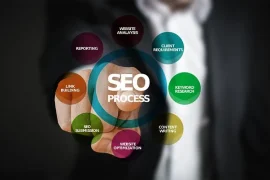
Launching a new webpage is exciting, but it can be tricky to get people to notice it. That is where SEO comes in. SEO helps your site be visible in search engines such as Google when individuals seek information, products, or services.
SEO can be a technical process, but once you have a clear checklist, you can manage it as a beginner. This step-by-step guide will show you everything a new site should do to establish strong, sustainable SEO right away.
1.The SEO Basics Before You Start
SEO is an abbreviation for search engine optimisation. It is the act of making your website perfect so it can be understood by search engines and shown to the right users. For new websites, SEO is important because it can generate free traffic over time.
There exist three principal types of SEO. On page SEO concerns the content, words, and features of the page. Off-page SEO is about links and online reputation. Technical SEO focuses on site speed, mobile friendliness, and indexing. All three work together.
Bots crawl search engines. These robots crawl Web pages, links and index information. When one searches, the engine ranks pages according to their relevance, quality, and user experience. Good SEO develops trust over time. Short-term wins can be achieved with quick tricks, but long-term SEO delivers lasting results.
2.Installation Of Necessary SEO Tools
Basic tracking tools should be the starting point for every new site. Google Search Console gives you an idea of how Google sees your site. Tou can submit your sitemap, test indexing problems and track search performance.
Visitors are tracked using Google Analytics. It provides the source of users, the duration of users and which page are most effective. A link between Analytics and the Search Console offers better insight into traffic and keywords.
Easy-to-use SEO tools are also helpful. Google Keyword Planner identifies keyword concepts. Ahrefs and Ubersuggest free tools provide information on search volume, competition, and backlinks. These products lead to smarter decisions without overwhelming beginners.
3.Selection of the Right Domain and Hosting
The name of your domain must be easy to remember, simple, and related to your topic or brand. Keep off long names and confusing spellings. A clean domain earns the trust of users and search engines.
HTTPS is essential. The SSL certificate will protect your site and safeguard user data. These search engines prioritise secure websites, and browsers alert users when an SSL certificate is not present.
Hosting speed matters. Fast websites are annoying and damaging to rankings. Select a
good hosting with high uptime. The server’s location is also a factor that influences
loading speed, particularly when the audience is local.
4.Keyword Research New Sites
Keywords research lets you know what people want to know. Search intent defines the
reason why a person searches. An informational intent seeks answers. Navigational
purpose aims at a given location. The intent of the transaction reveals an interest in
buying.
New websites must target low competition keywords. Long-tail keywords are the best
because they are more specific and easier to rank for. Rather than broad terms, aim for
phrases that are comparable to real questions.
Keyword mapping helps organize content. Related keywords for a single topic are
grouped so that each page has a clear focus. This prevents misunderstanding and
enhances rankings.
5.Online Organization and URL Maximization
The site’s simple design benefits users and search engines. Group related pages and
maintain clarity in navigation. Critical pages must be within a few clicks.
SEO-friendly URLs are succinct and provide a description. Do not use random numbers
or symbols. Use words which describe the page topic.
Internal linking is done on your site’s pages. It assists users in reading more content and
helps search engines understand the association among pages. A sitemap directs
search engines, and robots.txt limits what search engines can crawl.
6.Page SEO Checklist
Title tags inform search engines and users about a page’s content. Write clear titles
using keywords. Meta descriptions must induce clicks by summarizing the page value.
Use headings correctly. One H1, H2, and H3 section should be used on each page.
Insert keywords in content without coercing them.
Images need optimisation. Label files descriptively, include alt text, and compress files
to improve speed. Original, high-quality content remains the core of on-page SEO.
7.Content Creation For SEO
Write to people initially. Google rewards pages that solve problems. Novices need to
focus on depth rather than just words. Be as comprehensive as possible and be
accurate.
New content is an indicator of relevance. Revise old posts to keep them up to date. Do
not duplicate or thin content that adds minimal value, as this can damage rankings.
Regularity is better than quantity. Several good articles can do better than many poor
articles.
8.Technical SEO Essentials
It depends on mobile responsiveness. Most users use phones and search engines
favour mobile-friendly websites.
Page speed influences user satisfaction and rankings: image compression, caching,
and minification of extraneous code.
Resolved crawl errors and broken links with the Search Console. Simple schema
markup helps search engines understand content types. Important pages must be
indexed appropriately so they appear in search results.
9.Local SEO Installation Where Applicable
Local businesses should make a Google Business Profile. Add valid information and
select appropriate options
NAP consistency refers to maintaining your name, address and phone number
everywhere. Directories are a good source of local citations that build trust. Promote
the opinions of actual clients, which affect local rankings and user choices.
10.Off-Page SEO for New Websites
Backlinks are like votes of trust. It is not the amount of quality but quality itself.
Initiatives need to focus on safe strategies such as outreach, content sharing, and
partnerships.
Guest posting can build authority when done on relevant sites. On social media, pages
are not ranked directly; instead, they create awareness and brand recognition, which
facilitates SEO growth.
11.User Experience And SEO
Effective navigation keeps users active. Much less frustration is caused by clear menus
and a logical layout. Reduced bounces are an indication of quality to the search engine.
Engagement is enhanced by readable content, with short paragraphs and precise
separation. Core Web Vitals is a set of metrics that assesses speed, stability, and
interactivity. Improving these metrics improves user experience and rankings.
12.Monitoring And Measuring SEO Performance
Track keyword ranking to observe improvement. Monitor organic traffic growth with the
help of Analytics. Engagement metrics, such as time on page and pages per session,
indicate the quality of the content.
Use data to improve strategy. Fix under-performing update pages and add to high performing content. SEO is enhanced by trial and error
13.SEO Ways for Beginners
Overloading with keywords makes the reading unintelligible, and, worse, it affects the
ranking. Overlooking mobile users misses out on traffic. Purchase of backlinks at low
prices is dangerous.
Without research, one can only publish weak content. Not updating old posts is a waste
of ranking potential. Take no shortcuts and aim for quality.
14.SEO Clean-Up and Long-Term Development
SEO requires regular care. Overhaul content, conduct technical audits, and monitor
competitors. Take the best of what your niche does.
Scale content slowly. Gain power over time by being consistent and valuable. It is easier
to grow once there is trust.
Final Checklist Summary
Start with strong basics. Prepare tools, identify keywords, and create good content.
Streamline pages, monitor performance and prevent typical errors. SEO rewards
patience. Stick to it, remain user-friendly, and the outcomes will come automatically.